
In language learning, writing skills are not merely about arranging words in grammatically correct order, they also reflect the writer’s sophistication in thought and ability to use language appropriately for specific contexts. Particularly in a university environment, writing an email is not just a daily communication task, but also a challenge that requires combining proper language structure, discourse politeness, and skillful handling of different situations. So, how can a student craft an email that is correct, eloquent, respectful, and still delivers a clear message?
Writing emails in an academic setting may seem like a simple skill, but in reality, it demands much more. Unlike personal emails, which can be flexible and casual, emails sent to lecturers, departments, or organizations must be grammatically accurate, use polite language, and have clear, coherent structure to avoid misunderstandings or creating unintended impressions. This is why mastering academic email writing in English has become an essential part of developing both academic competence and professional communication skills for students.
Understanding these concerns, the Department of Student Affairs (DSA) collaborated with the School of Foreign Languages (UEH CELG) to organize an online language seminar titled “Effective Use of English at University: Essential Notes on Email Communication and Beyond.” The program was honored to feature Dr. Ton Nu Tuy Anh, an experienced academic in teaching English writing skills at UEH.

The Importance of Email Use in a University Context
In the opening presentation, the speaker shared notable research findings on common challenges faced by students, especially those using English as a second language when writing emails. These challenges ranged from using overly direct request structures and omitting softening language, to expressing messages that focus too heavily on personal needs. Real-life examples illustrated how even a minor error in address form, or a request lacking subtlety, could lead the recipient to misunderstand the writer’s attitude or intentions.

The speaker presented a real-life case and invited students to reflect on it
The program did not stop at theory. Participants were encouraged to actively analyze and improve emails through practical case exercises. From examples such as extension requests for assignments or notices of absence from exams, students were invited to assess the language effectiveness and discourse strategies used. Revised versions with more professional greetings, clear reasons, sincere apologies, and softer wording allowed students to clearly see the difference between an “ordinary” email and a “successful academic” email.
A short quiz on email language also helped participants review indirect structures such as “Could you possibly…” or “I was wondering if…” instead of relying solely on “Please”, which is a common mistake.

Small exercises were integrated to help students improve their own email-writing skills
Alongside the practical activities, pre- and post-event surveys were conducted to measure changes in student perceptions. Before the seminar, most participants admitted they had never received formal instruction on professional email writing in English and often felt confused when writing to lecturers. After the seminar, many shared that they now had a clearer understanding of language strategies, could identify emails appropriate for academic contexts, and recognized why context is just as important as grammar or vocabulary.
Held online, the seminar saw students actively sharing their personal challenges with academic email writing. The speaker’s friendly and inspiring approach created a safe learning environment where participants felt comfortable asking questions, interacting via the chat box, and joining the quiz to learn and improve together.

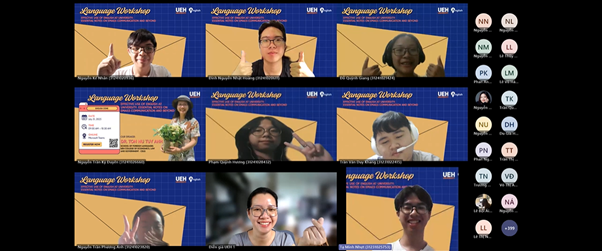
The seminar attracted active participation from UEH students across various faculties and institutes
As part of the English Zone project, these language workshop are organized regularly to introduce practical learning methods that inspire both UEH students and staff to enjoy learning English. This in turn helps build habits, spark curiosity, and enhance self-worth in an increasingly global environment.
More than a place to practice language skills, English Zone is a meeting point where students can rekindle their passion for learning, broaden their perspectives, and gain greater confidence in using English, both inside and outside the classroom.
To register and join upcoming activities, follow the UEH English Zone fanpage for the latest updates.
News & Photos: Department of Student Affairs (DSA)