

In the context of rapidly growing social media and popular culture, love and sexuality are often portrayed in a highly romanticized way. Scenes in films may show off romantic relationships, even though these actions may cross personal boundaries when there is no consent. Over time, personal boundaries become blurred, making it increasingly difficult to distinguish between healthy affection and violations disguised as love.
This lack of clarity around boundaries can lead to serious consequences such as coercion, abuse, or sexual harassment, even when the person causing harm may not realize they have crossed a line. What may seem trivial, an ambiguous comment or an inappropriate action can cause deep emotional and psychological harm. In romantic relationships, such behaviors are even more easily overlooked, as the word “love” is often used to justify actions and obscure feelings of discomfort or insecurity.
Many cases of sexual harassment committed under the guise of love stem from a lack of knowledge and understanding about consent and ethical principles in relationships. Understanding consent correctly in love and sexuality is essential for self-protection and for building a safe and healthy environment for oneself and the community.
What Is “Consent”?
Consent should not be interpreted emotionally or vaguely; it must be based on principles of voluntariness, clarity, mutual agreement, and reversibility meaning you always have the right to say “no” at any time. Understanding these characteristics helps prevent unnecessary misunderstandings in emotional and sexual situations.
It is important to note that silence should never be considered consent. You should clearly express whether you agree or disagree. Many people, out of fear of losing face or damaging a relationship, do not respond clearly, leading others to mistakenly assume consent.
Moreover, consent cannot arise from threats, coercion, manipulation, flattery, or intoxication. Any action or agreement made while feeling uncomfortable, pressured, or physically or mentally coerced cannot be considered consensual. Love does not imply an obligation to engage in sexual activity, and consent given once does not automatically apply to future situations. When both parties understand and respect these principles, relationships become safer, healthier, and more respectful.
Consent Criteria According to the F.R.I.E.S Model
Planned Parenthood, one of the most reputable sexual health education organizations, proposes the F.R.I.E.S model to clearly define consent. According to this model, consent includes five essential elements: Freely Given, Reversible, Informed, Enthusiastic, and Specific.
F – Freely Given: Consent is given voluntarily, without pressure, coercion, threats, or abuse of power. Decisions should be made without manipulation or the influence of drugs or alcohol.
R – Reversible: Consent can be withdrawn at any time. Agreeing to something once does not mean agreeing to it for all future occasions.
I – Informed: Consent requires a clear understanding of what is happening, without deception or withheld information. For example, if someone agrees to kissing but the other person later attempts a different sexual act, that is coercion and a violation of consent.
E – Enthusiastic: Consent should come from genuine desire and interest, not emotional pressure or expectations. Only do what you truly want to do, not what you feel obligated to do.
S – Specific: Consent must be clearly defined for each specific action. Agreeing to a hug does not mean agreeing to sexual intercourse, and agreeing to go out does not imply consent to physical intimacy.
Controlling behaviors are sometimes disguised as care. For example, asking for someone’s location “for peace of mind” may actually be excessive monitoring that restricts personal freedom; requesting social media passwords as proof of trust is an invasion of privacy; or asking for intimate photos,… sometimes later used as tools for control or coercion.
Many people, in an effort to express love, may unintentionally become controlling and intrusive. Recognizing these traps helps individuals avoid toxic relationships, protect personal freedom, and build love based on mutual respect.
Protecting personal boundaries helps make love safe and respectful (Source: iconscout.com).
Correctly identifying sexual harassment is key to prevention and self-protection. Harassment can take many forms and is often subtle, making it difficult for victims to recognize immediately.
Verbally, it may include suggestive comments, excessive flirting, or remarks about someone’s body or personal traits that cause discomfort, embarrassment, or fear.
Behaviorally, harassment includes any form of physical contact without consent, from touching, stroking, or forced hugging to direct sexual assault. Even in close relationships, testing physical contact “to see the reaction” is a violation if there is no clear consent. Such behaviors can cause both physical and psychological harm, leaving victims feeling confused, ashamed, or guilty despite having done nothing wrong.
In messaging and online environments, harassment may involve sending explicit images or videos often with coercive or threatening intent or pressuring others to send private images. These actions are especially dangerous because they can be stored and later used for blackmail, threats, or manipulation.
Harassment can also occur through the abuse of environment or power, such as using alcohol, private spaces, or authority positions (e.g., lecturer–student, boss–employee) to commit violations. These cases are often harder to detect because victims face intense psychological pressure and feel unable to resist.
What Can You Do to Protect Yourself?
To protect yourself in a relationship, clearly defining personal boundaries is essential. This means knowing what you are comfortable with and what crosses your limits and saying “no” when necessary.
An important part of self-protection is recognizing warning signs in a relationship: manipulation, material inducements, excessive control, or requests for intimate photos often signal control rather than genuine care. When these signs appear, it is time to reassess your boundaries and establish clear rules.
Regarding sensitive images, limit or avoid sending private photos. If you choose to do so, consider using applications with auto-delete features or storing images securely with controlled access.
When facing unsafe situations or violations, knowing how to document evidence is crucial. Screenshots of conversations, saved messages, preserved images, and notes on time and context can become valuable evidence for reporting later.
In addition, always keep emergency numbers such as 113 readily available. If you sense danger, carefully consider whether to go to a meeting; if you do, prepare a safety plan and ensure you always have a secure exit.
Finally, learning basic self-defense skills is a highly effective option to increase confidence and preparedness in potentially dangerous situations.
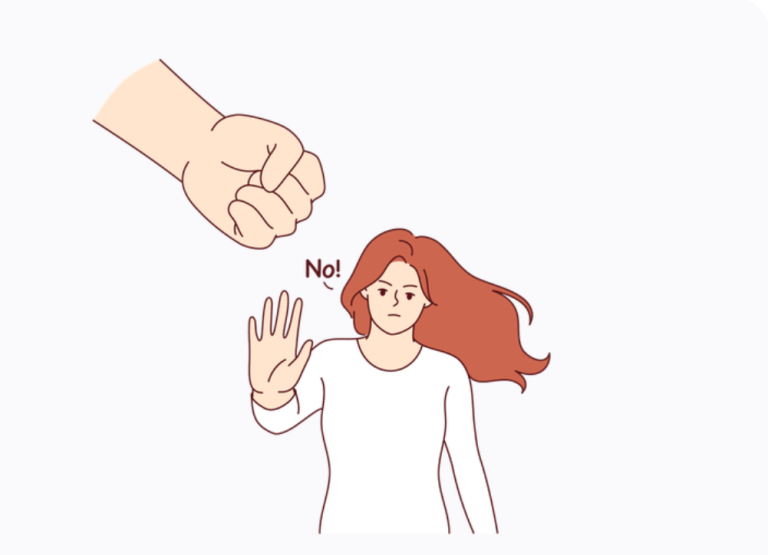
Say “no” when necessary (Source: iconscout.com).
What Should You Do After an Incident Occurs?
It is never the victim’s fault—this principle must be reaffirmed repeatedly. Feelings of guilt, shame, or fear of judgment often silence victims, prolonging harm and delaying support. Speaking up, even to just one trusted person, is a courageous and crucial first step toward recovery.
When seeking help, start with those closest to you—family members, close friends, or anyone you feel safe confiding in. They can help stabilize your emotions and accompany you through next steps, such as consulting professionals or addressing legal matters.
If you prefer not to confide in acquaintances, you can seek support from psychologists, lawyers, or reputable social organizations experienced in assisting victims and ensuring confidentiality.
Additionally, consulting psychological support centers, hotlines, or official resources can help you understand your rights and safe response options. These resources often provide guidance on evidence preservation, exiting risky situations, reporting procedures, and legal protections.
Most importantly, allow yourself to live in alignment with your personal values. No one has the right to harm, control, or invade your privacy. Reaffirming boundaries, reclaiming your voice, and restoring your sense of agency are essential steps in healing.
Whether you are helping yourself or supporting someone else, always remember: you deserve to be safe, respected, and never to endure this alone.
The UEH Student Affairs Department (DSA) is always here to support you. If you need to share or seek assistance, please email dsa@ueh.edu.vn
or register for counseling at:
Learn more about sexual harassment prevention activities at:
Love is mutual respect—not coercion or a transaction of emotional or physical cost. Intimacy is only meaningful when both parties freely consent, feel safe, and respect each other’s rights and desires.
Because relationships are rooted in personal freedom, maintaining clear boundaries, recognizing warning signs, and knowing how to protect oneself are shared responsibilities. Together, they contribute to a healthier society and help prevent violations and sexual violence.
Always trust your self-worth, respect others, and uphold these values in relationships so that life remains meaningful—and love never becomes a source of lasting harm.
News & Photos: Department of Student Affairs (DSA)
References
[1] What Is Sexual Consent? Planned Parenthood.
[2] Safety Planning Around Sexual Abuse. The Hotline (2025).
[3] Qiwei, L. et al. (2024). Feminist Interaction Techniques: Deterring Non-Consensual Screenshots. arXiv.
[4] Tips to Stay Safe. Title IX Office (2024).