
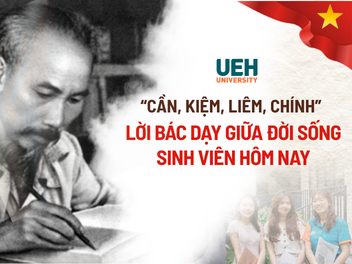
“Talent without virtue is useless. Virtue without talent makes it difficult to accomplish anything”.
More than half a century has passed, yet this saying by Hồ Chí Minh remains as relevant as ever, serving as a profound reminder of the harmony between virtue and talent. Among the moral values he left behind, the four virtues: diligence, thrift, integrity, and righteousness are regarded as the core foundation, the roots that shape each individual into a responsible and ethical citizen. However, in the fast-paced rhythm of the digital era, where students juggle academic pressure, part-time jobs, social relationships, and the irresistible pull of social media, have these values become distant? In this article, we revisit President Hồ Chí Minh’s teachings and explore how students can practice these virtues through small, everyday actions.
What do “diligence, thrift, integrity, and righteousness” mean?
President Hồ Chí Minh once explained in simple terms: “Diligence means being hardworking, persistent, and resilient. A blade becomes sharp through constant sharpening; a field yields good crops when weeds are regularly removed.” Diligence (Cần) means being proactive, responsible, and committed to self-improvement. It is reflected in planning one’s studies independently, completing tasks on time, and continuously seeking knowledge and skills beyond the curriculum. In essence, diligence is an active attitude toward life, free from laziness and dependence.
Thrift (Kiệm) means being economical, distinguishing between “needs” and “wants,” and valuing resources. A thrifty student carefully considers each expense, for instance, using library books instead of buying new ones, or utilizing free learning materials instead of wasting money. Thrift also means not wasting time, the most valuable asset of youth.
Integrity (Liêm) is honesty and moral purity in the smallest actions: no cheating in exams, no plagiarism, no buying or selling assignments. It means keeping promises, honoring commitments, and avoiding personal gain in collective activities. Integrity is the foundation of personal credibility, an asset that lasts a lifetime.
Righteousness (Chính) means being upright, having the courage to stand for what is right, and acting accordingly. It involves responsibility toward the community, respect for rules and discipline, and most importantly, consistency between words and actions.
When practiced daily, these four virtues form a sustainable moral habit. As President Hồ Chí Minh once said: “Heaven has four seasons: spring, summer, autumn, and winter. Earth has four directions: east, west, south, and north. Humans have four virtues: diligence, thrift, integrity, and righteousness. Without one season, heaven is incomplete. Without one direction, the Earth is incomplete. Without one virtue, a person is incomplete.”
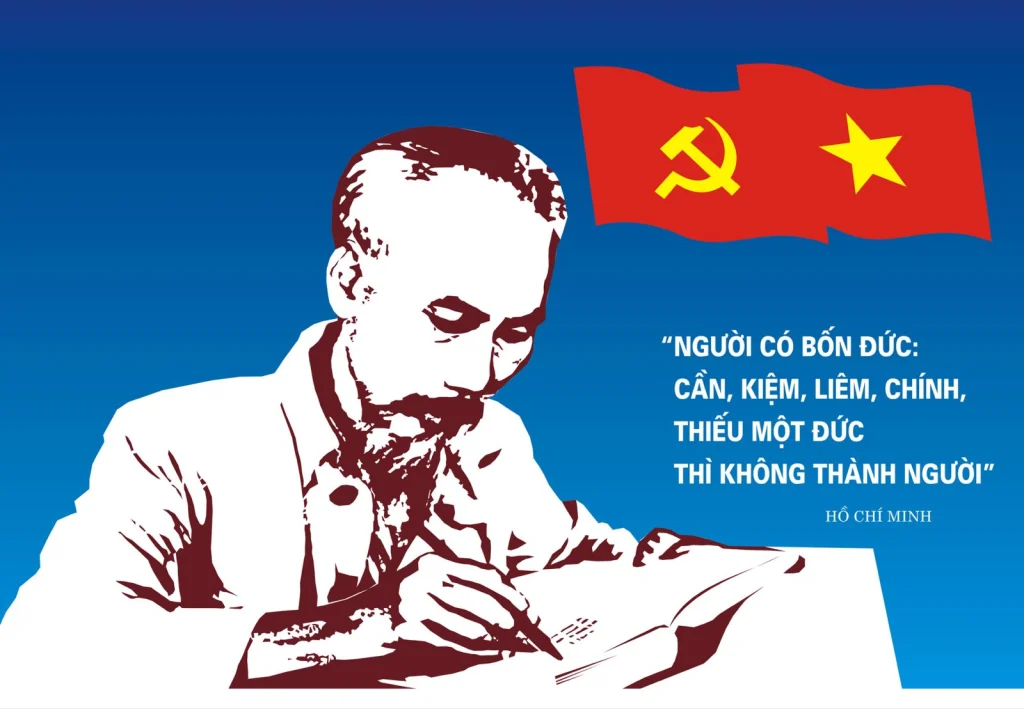
Four core virtues: diligence, thrift, integrity, and righteousness form the foundation of true character
(Source: Vietnam.vn )
Invisible barriers: Why is it difficult for students to practice these virtues?
Living by these virtues in a modern world full of temptations and pressures is far from easy, as many invisible barriers exist.
The first barrier is academic pressure. In a highly competitive environment, students strive for high grades, certificates, and impressive academic profiles. This pressure can lead some to compromise integrity in pursuit of quick results, engaging in dishonest practices such as cheating or academic misconduct. Such actions not only violate fairness but also erode personal integrity.
Social media presents another challenge, particularly to thrift. Luxurious check-ins, expensive meals, and extravagant trips shared on platforms like Facebook and Instagram create unrealistic comparisons. Studies show that up to 80% of students admit that social media increases the tendency toward materialistic lifestyles and excessive consumption. In an effort to fit in, many overspend or even incur debt, reflecting a lack of thrift.

Social pressure and digital lifestyles can blur the line between needs and desires
(Source: https://thientuong.com.vn/)
Moreover, herd mentality exerts a powerful influence. When unethical behaviors become widespread and go unpunished, they gradually appear acceptable. Even students with strong principles may justify following the crowd to avoid disadvantage. This weakens righteousness and blurs the line between right and wrong.
Finally, a lack of self-management skills is a subtle yet significant barrier. Without proper planning and control over time and finances, students may fall into a cycle of procrastination (lack of diligence), overspending (lack of thrift), and dishonesty in meeting academic demands (lack of integrity).
These pressures, like invisible threads, make it a real challenge for students to practice these virtues today, leading to serious consequences over time.
What do students lose without these virtues?
Without diligence, students lose opportunities for personal growth. In a dynamic environment like UEH, those who lack initiative and discipline are easily left behind.
Without thrift, financial pressure emerges. Poor spending habits not only lead to short-term difficulties but also disrupt long-term plans such as further education or entrepreneurship.
Without integrity, the most valuable asset, trust, is lost. Once credibility is damaged, it is extremely difficult to rebuild, especially in environments where trust underpins all relationships.
Without righteousness, one drifts toward wrongdoing. Gradually tolerating unethical behavior leads to inconsistency between words and actions, ultimately eroding one’s moral character.

When core values are compromised, the consequences accumulate over time
(Source: https://tramcam.org/)
So what must be done to avoid falling into those consequences? The answer is not far away. It is to transform these seemingly grand virtues into very small, concrete actions, repeated daily until they become habits.
How can students practice these virtues daily?
Diligence begins with forming habits: planning each day, actively seeking learning opportunities, and completing tasks without procrastination. This means each evening, spend five minutes planning the next day. Proactively seek learning opportunities; don’t wait for others to remind you. And above all, follow a simple principle: do today’s work today, not tomorrow. As Uncle Hồ taught: “Studiously learning makes you knowledgeable. Studiously thinking brings creativity. Studiously working brings certain success.”
Thrift involves mindful consumption. Before spending, pause and ask: “Is this a need or a want?” It is about valuing effort and avoiding waste, not being stingy; it is respecting the efforts of your parents and yourself, and not wasting time or money on things that lack real value.
Integrity starts with honesty in small actions: completing assignments independently, admitting mistakes, and maintaining authenticity. Do your own assignments, take your own exams, even if the results may not be what you hoped. When wrong, dare to admit it; when you achieve something, don’t exaggerate, but also don’t deny your ability. Remember that trust is built from thousands of small, honest acts, but can collapse after just one dishonest act.
Righteousness requires courage: standing firm in one’s values, refusing to follow wrongdoing, and speaking up when necessary. Don’t follow the crowd if you know it’s wrong. Speak up when you see injustice, dare to refuse decisively when pulled into something unethical.
Living “cần, kiệm, liêm, chính”: A meaningful way to honor President Hồ Chí Minh
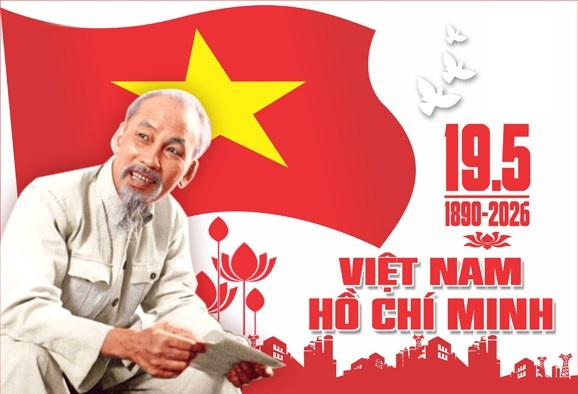
Commemorating the 136th birthday of President Ho Chi Minh (May 19, 1890 – May 19, 2026)
(Source: https://xuanmai.hanoi.gov.vn/)
On the occasion of the 136th anniversary of President Hồ Chí Minh’s birth (May 19, 1890 – May 19, 2026), let us honor his legacy and reflect on the simple yet profound lessons he left behind. Throughout his life, he embodied “diligence, thrift, integrity, and righteousness” in every action and decision.
As young people in a new era, we should not limit our gratitude to ceremonial gestures or written reflections. The most meaningful way to honor Uncle Hồ is to practice these values in our daily lives as students – learning, working, and living in alignment with Hồ Chí Minh’s teachings. By starting with small but consistent actions, students today can build a solid foundation for the future, where competence goes hand in hand with character, and success is rooted in sustainable values. This is the most practical way for the younger generation to inherit and continue the legacy that President Hồ Chí Minh devoted his life to building.
News and images by: Department of Student Affairs (DSA)
REFERENCES
[1] Ho Chi Minh: Complete Works, National Political Publishing House, Hanoi, 2011.
[2] Ho Chi Minh National Academy of Politics (2018). The work “Can, Kiem, Lien, Chinh” by President Ho Chi Minh.
[3] Ngoc, T. T. M. Vietnamese Student Ethics: Current Situation and Solutions. VNU Journal of Science. Retrieved April 1, 2026, from https://vjol.info.vn/index.php/khxhvn/article/view/23234
[4] Plagiarism and Academic Fraud: Pragmatic Reactions to Modern Educational Pressures. Journal of Education, March 20, 2025. Retrieved April 1, 2026, from https://tapchigiaoduc.edu.vn
[5] Hiep, T. T., Nhan, T. V., & Huyen, T. T. T. (2025). Factors Affecting Personal Financial Management Behavior of Economics Students in Ho Chi Minh City. Journal of Economics and Forecasting. Retrieved April 1, 2026 from https://kinhtevadubao.vn/cac-nhan-to-tac-dong-hanh-vi-quan-ly-tai-chinh-ca-nhan-cua-sinh-vien-khoi-nganh-kinh-te-tai-tp-ho-chi-minh-31059.html
[6] Lien, H. T. K. (2024). The Two-Sided Impact of Social Media on Student Lifestyles in Da Nang City Today. State Management Journal. Retrieved April 1, 2026, from https://www.quanlynhanuoc.vn/2024/06/04/tac-dong-hai-mat-cua-mang-xa-hoi-den-loi-song-cua-sinh-vien-o-thanh-pho-da-nang-hien-nay/