
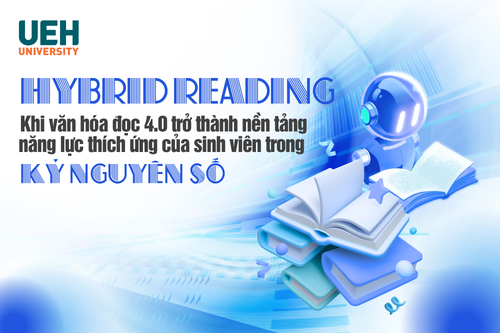
In the context of digital transformation reshaping the way people access knowledge, students’ reading culture no longer remains in its traditional form. Reading today is not only about receiving information but also about the ability to filter content and connect knowledge across disciplines in the digital environment. In response to these changes, the Hybrid Reading model – combining deep reading, digital reading, and technological support – is gradually becoming a new approach that contributes to the development of lifelong learning capacity and adaptability for students in the 4.0 era.

Hybrid Reading – A New Framework for Reading Culture in the Digital Age
The rapid development of digital technology is significantly changing the way people read, receive, and process information. In today’s learning environment, students no longer read only printed books or paper-based materials as before, but increasingly turn to digital platforms such as online articles, e-books, podcasts, academic videos, and infographics.
This shift creates the need for a new approach to reading culture — not simply reading more, but reading more flexibly and effectively across different environments. From this, the concept of Hybrid Reading has emerged as a reading approach suited to the educational context of the digital age.
Hybrid Reading is a multidimensional concept that emphasizes the ability to combine different forms and methods of reading, including:
- Combining printed and digital reading (online articles, e-books, podcasts with transcripts, infographics, etc.);
- Integrating multiple forms of content;
- Combining reading comprehension, critical thinking, and information processing skills;
- Blending technology with traditional learning methods.
In other words, Hybrid Reading is the ability to read flexibly across multiple environments, formats, and purposes. Researchers describe this as hybrid literacy practices that bridge traditional academic environments and digital media environments.

E-book and printed books (Source: Internet)
Hybrid Reading – Is It Really Effective?
In the digital age, most students today prioritize reading on phones, tablets, or laptops because of the convenience and speed of accessing information. With just a few taps, learners can open dozens of documents, search instantly, and study anywhere. This has led many people to believe that online reading is gradually replacing printed books entirely.
However, many international studies show that reading in digital environments does not always produce better learning outcomes. Although students often feel that they understand materials better when reading on screens, research findings indicate that information retention and deep comprehension are usually higher when reading on paper, especially with long or academic texts.
The reason lies in the way people interact with each reading environment. When reading on screens, learners tend to read quickly, skim content, and constantly shift their attention between different materials. Digital platforms also often come with notifications, links, or short-form content that interrupt concentration. This reduces learners’ ability to process information deeply and connect complex ideas.
Meanwhile, reading on paper usually creates a more focused and linear experience. Readers can easily take notes, highlight content, follow text structures, and maintain attention for longer periods. Therefore, for materials that require analytical thinking or long-term memory, printed books and paper-based materials still show clear advantages.
Each form of reading has its own strengths. Digital environments are suitable for quick reference, updating new information, and multimedia learning, while reading on paper is more effective for activities that require deep concentration and systematic thinking. This is also the core spirit of Hybrid Reading — not rigidly choosing only one form of reading, but flexibly combining printed and digital reading depending on learning goals.
In modern educational research, Hybrid Reading is considered a competence that helps learners adapt to digital environments and effectively process the massive amount of information in the 21st century. This is especially important for first- and second-year students, who are transitioning from high school learning methods to the university environment. In high school, learners are often accustomed to receiving ready-made knowledge, whereas at university, students must independently read materials, conduct research, analyze information, and build their own academic perspectives.
Without effective reading skills, students are more likely to learn passively, rely on summaries, or develop an “illusion of understanding” from consuming too much short-form content on social media. Reading then remains only at the level of receiving information instead of generating thought. Hybrid Reading, therefore, is not simply about “reading more,” but about learning how to read strategically — knowing when to read quickly, when to read deeply, and when to critically evaluate information. The ability to choose the appropriate reading environment for each learning goal is precisely the manifestation of Hybrid Reading.
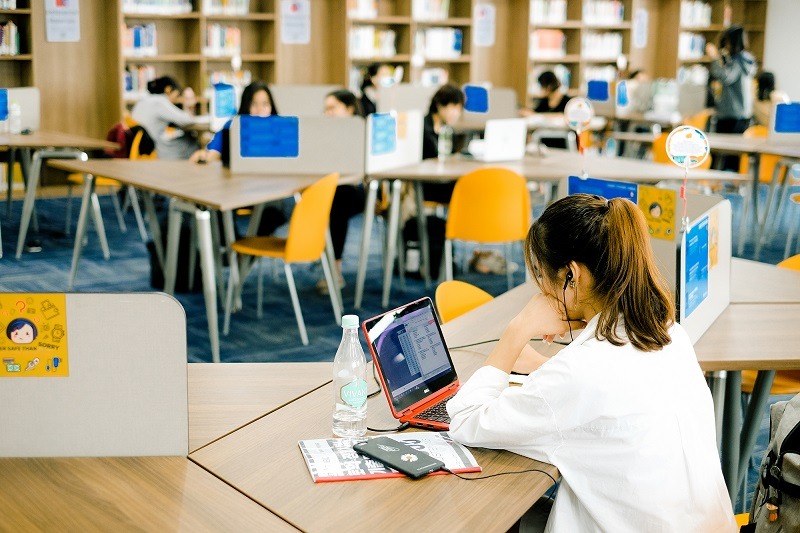
UEH Students Combine Reading Layers to Understand, Connect, and Apply Knowledge
Active reading instead of merely receiving information
An effective reader does not read only to “know,” but also to ask questions. When approaching any content, students should ask themselves:
- Is this information reliable?
- Are there alternative perspectives?
- Have I truly understood the issue?
The ability to think critically during reading helps learners avoid one-dimensional information intake, fosters independent thinking, and trains deep concentration. Students can start with small habits such as:
- Reading continuously for 15–20 minutes without using a phone
- Taking short notes after reading
- Summarizing content in their own words
These activities help the brain move away from the habit of “quick skimming” and gradually rebuild the ability for deep reading — an important factor for university learning and long-term intellectual development.
As AI becomes increasingly capable of summarizing documents, searching for information, and answering questions within seconds, the value of students no longer lies in having access to more information than others. What matters more is the ability to understand deeply, analyze, think critically, and connect knowledge.
Hybrid Reading, therefore, is not merely a new learning trend, but is gradually becoming a core competence for students in the 21st century.
UEH and the Reading Culture 4.0 Ecosystem
In the context of educational innovation, the University of Economics Ho Chi Minh City (UEH) is gradually building an ecosystem that supports reading culture in a modern direction. From a traditional library model, UEH has developed a Smart Library system with digital resources, open learning spaces, and advanced learning support tools.
Illustrative Image of UEH Smart Library Space
This transformation not only helps students access knowledge more conveniently, but also creates conditions for implementing new reading approaches such as Hybrid Reading. In addition, academic activities, workshops, clubs, and learning communities at UEH also contribute to promoting a reading culture that is proactive, interactive, and creative.
These conditions create opportunities for students not only to read more, but also to read smarter, thereby improving their adaptability in future learning and working environments.
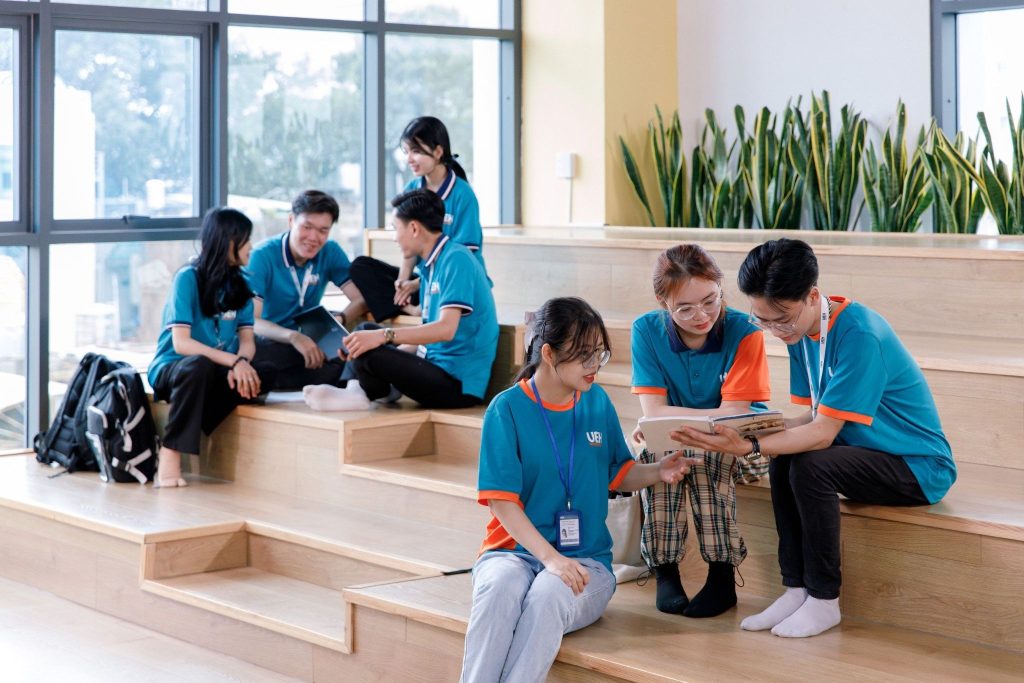
UEH Students Combine Reading, Discussion, and Digital Resources in Open Learning Spaces
Reading culture in the digital era is shifting from traditional models to more flexible and diverse forms. In this context, Hybrid Reading is not only a reading method but also a foundation that helps students develop lifelong learning capacity and adaptability to the constant changes of society. More importantly, adaptability does not begin with technology, but with the way people approach and master knowledge. When students know how to read strategically, deeply, and with connection, learning will no longer be a burden, but will become a sustainable journey of development in the digital age.
News and images by: Department of Student Affairs (DSA)
REFERENCES
- Báo Văn nghệ (2025, February 20): Reading Culture in the Digital Age
- Dân trí (2025, May 5): The AI Storm and the Risk of “Erasing” Reading Culture Among Students
- Vietnamplus (2025, April 26): Reading Culture in the Digital Age: How to Use AI Effectively?
- Dudley Editions (2025, August 19): The Future of Reading is Hybrid
- Allen MM, Petersen DB. Reading Comprehension: A Proposal for a Hybrid Approach. Perspectives on Language Learning and Education. 2011;18(1):13–19 DOI: 10.1044/lle18.1.13
- Singer LM, Alexander PA. Reading on Paper and Digitally: What the Past Decades of Empirical Research Reveal. Review of Educational Research. 2017;87(6):1007–1041 DOI: 10.3102/0034654317722961
- Ware PD, Warschauer M. Hybrid literacy texts and practices in technology-intensive environments. International Journal of Educational Research. 2005;43(7–8):432–445 DOI: 10.1016/j.ijer.2006.07.008
- Kersten J, Pardo L. Finessing and Hybridizing: Innovative Literacy Practices in Reading First Classrooms. The Reading Teacher. 2007;61(2):146–154 DOI: 10.1598/rt.61.2.4
- Singer Trakhman LM, Alexander PA, Silverman AB. Profiling reading in print and digital mediums. Learning and Instruction. 2018;57:5–17 DOI: 10.1016/j.learninstruc.2018.04.001
- Coiro J. Toward a Multifaceted Heuristic of Digital Reading to Inform Assessment, Research, Practice, and Policy. Reading Research Quarterly. 2020;56(1):9–31 DOI: 10.1002/rrq.302
- Singer LM, Alexander PA. Reading Across Mediums: Effects of Reading Digital and Print Texts on Comprehension and Calibration. The Journal of Experimental Education. 2016;85(1):155–172 DOI: 10.1080/00220973.2016.1143794
- Macaruso P, Wilkes S, Prescott JE. An investigation of blended learning to support reading instruction in elementary schools. Educational Technology Research and Development. 2020;68(6):2839–2859 DOI: 10.1007/s11423-020-09785-2
- Prescott JE, Bundschuh K, Kazakoff ER, Macaruso P. Elementary school–wide implementation of a blended learning program for reading intervention. The Journal of Educational Research. 2017;111(4):497–506 DOI: 10.1080/00220671.2017.1302914
- Goodwin AP, Cho SJ, Reynolds D, Brady K, Salas J. Digital Versus Paper Reading Processes and Links to Comprehension for Middle School Students. American Educational Research Journal. 2019;57(4):1693–1723 DOI: 10.3102/0002831219890300
- Bintz WP, Ciecierski LM. Hybrid Text: An Engaging Genre to Teach Content Area Material Across the Curriculum. The Reading Teacher. 2017;71(1):61–69 DOI: 10.1002/trtr.1560
- Kuula T, Vihavainen S, Seisto A. Playful Learning with Hybrid School Books. In: Proceedings of the 13th International MindTrek Conference: Everyday Life in the Ubiquitous Era. ACM; 2009:159–162 DOI: 10.1145/1621841.1621882
- Baron NS. Reading in a digital age. Phi Delta Kappan. 2017;99(2):15–20 DOI: 10.1177/0031721717734184
- Reich SM, Yau JC, Xu Y, Muskat T, Uvalle J, Cannata D. Digital or Print? A Comparison of Preschoolers’ Comprehension, Vocabulary, and Engagement From a Print Book and an e-Book. AERA Open. 2019;5(3):1–16 DOI: 10.1177/2332858419878389