

In a context where digital platforms increasingly intervene deeply in personal experiences, the phenomenon of users continuously receiving content aligned with their existing viewpoints has become widespread. This raises concerns about the ability to access diverse, multidimensional information. Therefore, recognizing and overcoming this limitation is the first step toward mastering critical thinking, improving academic quality, and preparing for a career in a rapidly changing world.

What is an Echo Chamber?
In the data-driven era, digital platforms prioritize user experience through content personalization, which may inadvertently limit informational diversity. The concept of an echo chamber is defined in the comprehensive review by Hartmann et al. (2025) as an environment in which an individual is primarily exposed to viewpoints and information that reinforce existing beliefs, while opposing perspectives are obscured or excluded. Imagine a room with walls that reflect sound. In that space, every word you speak is echoed repeatedly, and no external sound can enter. That is precisely the experience of being inside an echo chamber – where you only hear yourself and those who share your views.
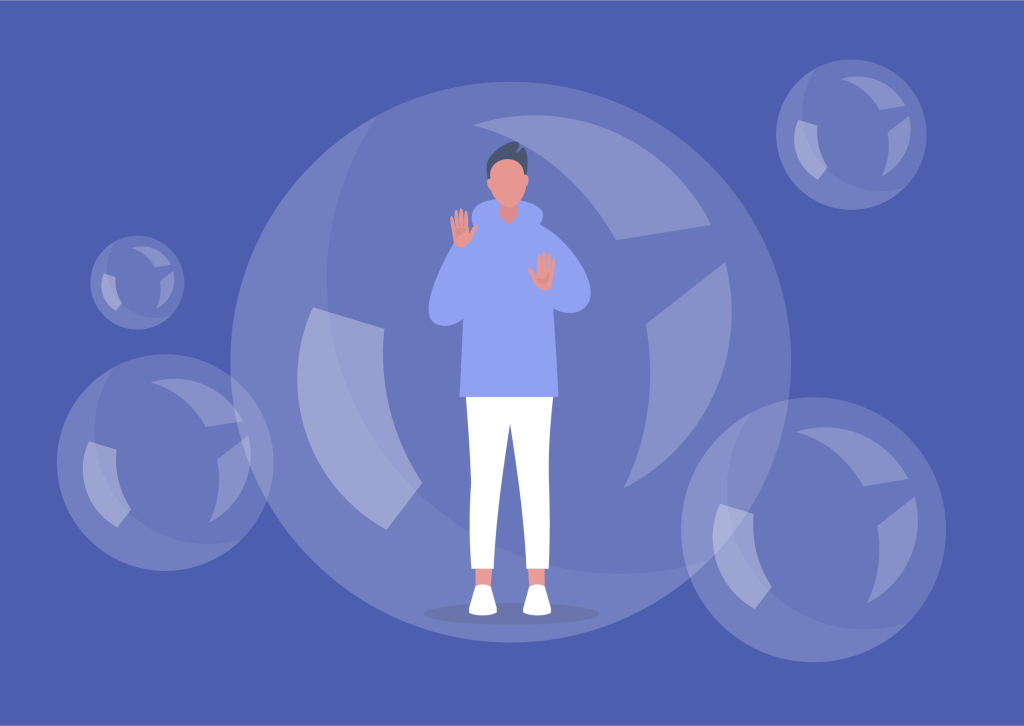
Personalization algorithms confine users within an invisible information echo chamber
(Source: Psychology of Technology Institute)
Closely related is the concept of the filter bubble, introduced by Eli Pariser (2011), which describes the isolation created when algorithms predict and display content based on users’ online behavior. For example, a student interested in environmental protection may only encounter content supporting renewable energy, while arguments about economic costs or technical challenges disappear from their feed. This is due to platform design: their goal is to maximize user engagement, and the most effective way is to show content users are likely to enjoy.
Formation Mechanism: The Interaction Between Algorithms and Psychology
The echo chamber effect is reinforced by two main factors operating as a self-reinforcing loop. First, algorithmic filtering (filter bubbles): Platforms like Facebook, YouTube, and TikTok use machine learning recommendation systems that analyze thousands of behavioral signals, such as what links you click, how long you watch a video, and what content you skip. From this data, algorithms build models of your preferences, tendencies, and even emotional states. As Pariser (2011) noted, this creates a loop that isolates users from information outside their comfort zone.
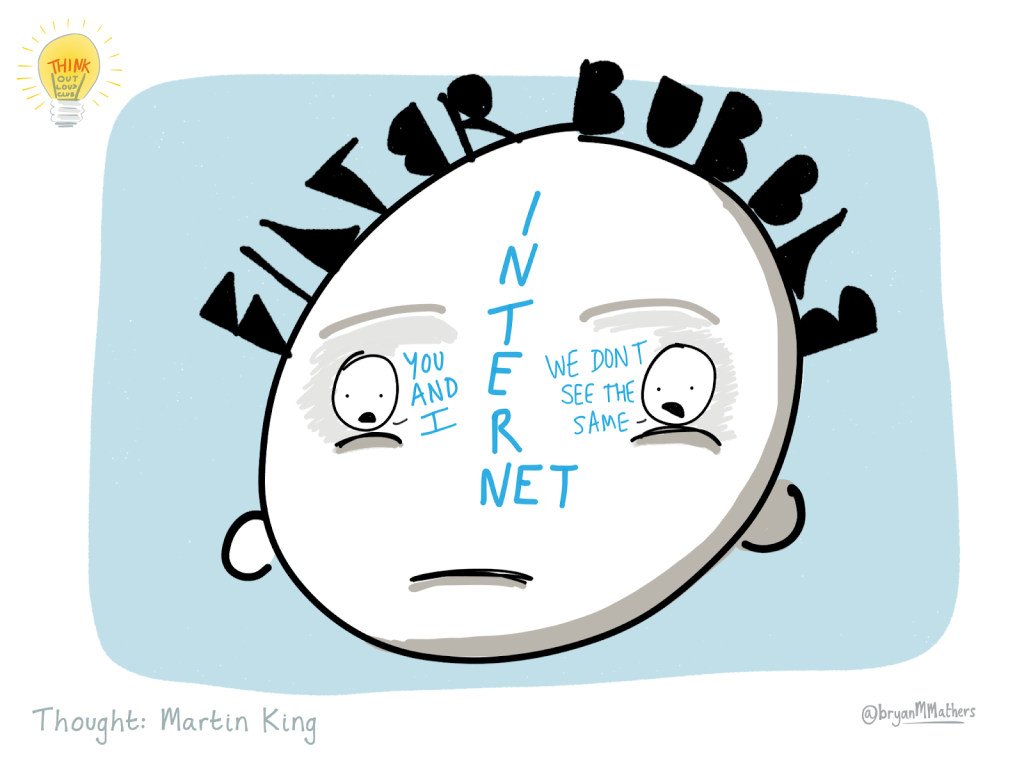
Filter bubble
(Source: Visual Thinkery – Stories and Cartoons )
Second, confirmation bias: Psychologically, humans tend to seek and prioritize information that confirms their beliefs while avoiding or rejecting opposing evidence. This cognitive mechanism helps reduce mental effort. However, in digital environments, it becomes an unintended ally of algorithms. Research by Zimmer et al. (2019) highlights that selective information consumption is a key factor in the formation and persistence of echo chambers.
Silent Consequences for Thinking and Academic Capacity
Prolonged exposure to echo chambers can lead to significant consequences.
First, it limits knowledge and creates an illusion of omniscience. Students may mistakenly believe they fully understand a topic, reducing motivation to explore alternative perspectives. When all visible content aligns with prior beliefs, it creates the false impression that truth is one-dimensional, leading to a dangerous “knowledge gap”, not knowing what one does not know.
Second, echo chambers weaken critical thinking. Critical thinking is not innate but developed through exposure to diverse and conflicting arguments. Without such exposure, analytical thinking becomes less flexible, increasing vulnerability to misinformation.
Third, the absence of “external voices” creates barriers to collaboration and professional adaptability. A lack of tolerance for differing viewpoints, an outcome of prolonged exposure to echo chambers, can hinder teamwork, academic discussions, and adaptation to diverse professional environments after graduation.
How to Break Out of the Echo Chamber?
Echo chambers arise not only from external systems but also from the internal “self.” The following strategies can help students overcome this “confinement effect”:
Actively diversify information sources: Instead of allowing algorithms to decide, proactively seek out and follow experts, organizations, and media outlets with opposing or at least differing viewpoints.
Apply steel-manning instead of straw-manning: In debates, rather than attacking the weakest version of an opponent’s argument, reconstruct their argument in its strongest and most reasonable form before responding. This ensures fairness and depth while fostering multidimensional understanding.
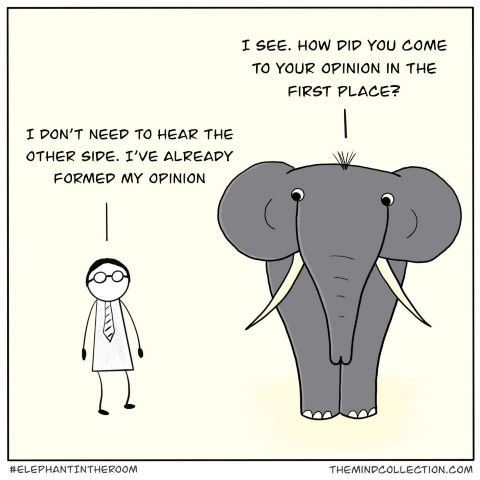
Steelmanning: Seeking truth by constructing the strongest version of the opposing argument
(Source: The Mind Collection)
Utilize anonymous and objective search modes: Conduct information searches without logging into social media accounts or use private browsing modes to obtain more objective perspectives, free from personalized influence. On platforms such as YouTube and Google, periodically clear browsing history or deliberately search for opposing content to “disrupt” the algorithm.
Prioritize real-world interaction over virtual engagement: Participate in academic activities such as seminars, workshops, specialized clubs, or events organized by student associations. Real-world environments with speakers, experts, and peers from diverse backgrounds provide exposure to multiple perspectives and help overcome algorithmic limitations. They also offer opportunities to practice listening and critical discussion in a safe space.
Escaping the Echo Chamber So the World Is Not Just an Echo of Yourself
A multi-dimensional worldview extends beyond the framework of information shaped by personalization algorithms. Recognizing and proactively escaping the echo chamber state is not only a requirement for developing independent thinking but also a foundation for building the adaptability and competency needed for success in an ever-changing academic and professional environment. There is no way to turn off the echo chamber overnight; it is a continuous training process that requires patience and courage.
News and images by: Department of Student Affairs (DSA)
References
- Hartmann, M., et al. (2025). Echo chambers in digital environments: A comprehensive review. Journal of Digital Society.
- Pariser, E. (2011). The Filter Bubble: What the Internet Is Hiding from You. Penguin Press.
- Zimmer, F., Scheibe, K., & Stock, W. G. (2019). “Confirmation bias in social media – a content analysis”. Journal of Information Technology & Politics, 16(3), 213-228.
- Bowlby, J. (1969). Attachment and loss: Vol. 1. Attachment. Basic Books.